
For years, many of the nation’s largest trucking companies have supplemented federally required urine testing with hair drug testing for one simple reason: they believe it helps create safer roads.
Now, one of the largest commercial driver drug testing studies ever conducted provides compelling evidence to support that decision.
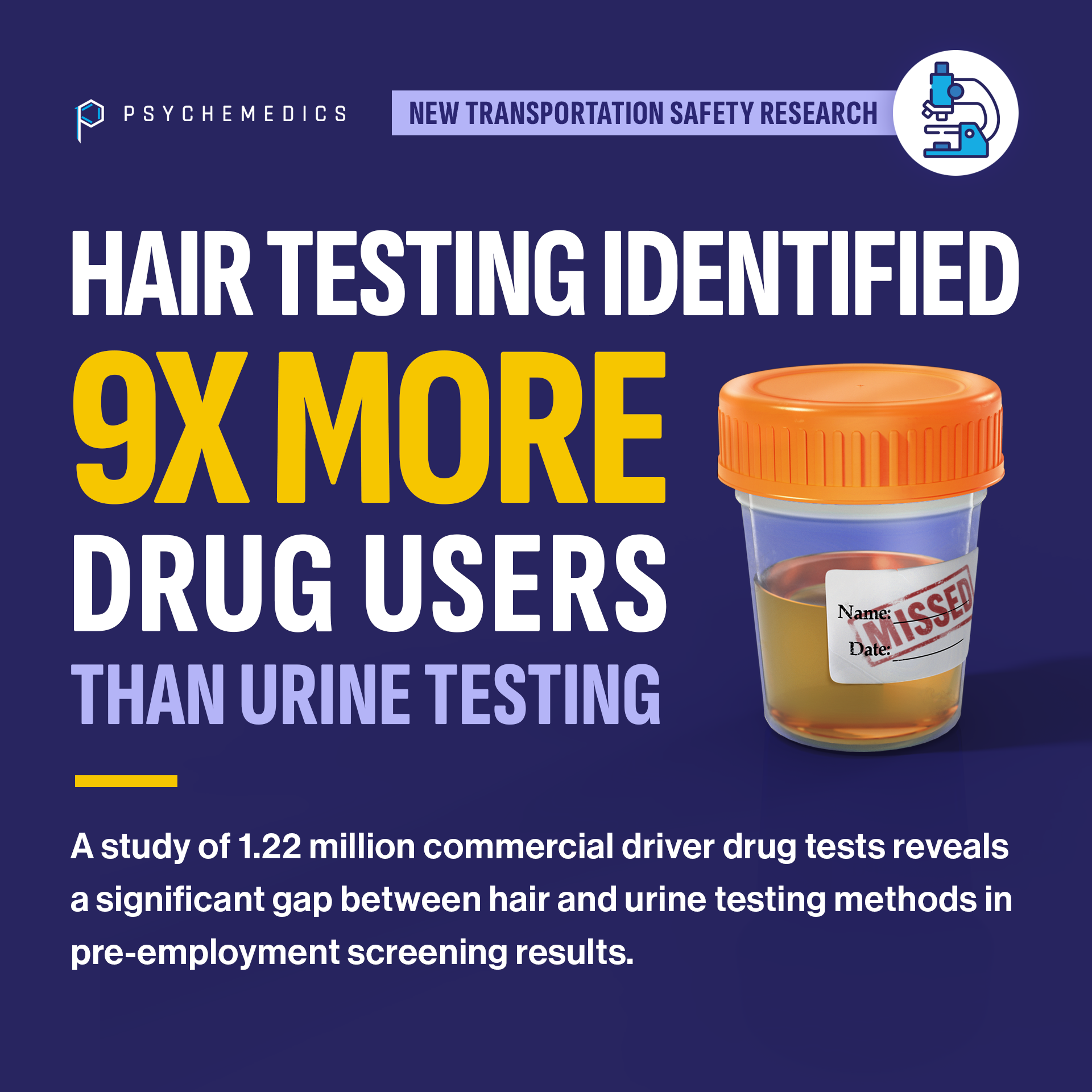
A new report from researchers at the University of Central Arkansas and the University of Tennessee analyzed more than 1.22 million pre-employment drug tests conducted between 2017 and 2025. The findings were clear: hair testing identified nine times more drug users than federally mandated urine testing alone.
Hair Testing Identified Nearly 30,000 More Drug Users
Across the nine-year study period, participating carriers conducted more than 604,000 hair tests and 618,000 urine tests.
The results were striking:
- Hair testing produced a 5.55% positivity rate.
- Urine testing produced a 0.59% positivity rate.
- Hair testing identified 33,527 drug-positive applicants compared to just 3,677 identified through urine testing.
In practical terms, researchers concluded that hair testing was approximately nine times more effective at identifying drug users during the pre-employment screening process.
For an industry responsible for operating 80,000-pound commercial vehicles on public roadways, that difference matters.
Why the Difference?
The answer lies in the science.
Urine testing is highly effective at identifying very recent drug use. Hair testing, however, provides a substantially longer detection window and is better positioned to identify patterns of drug use over time.
Hair testing also offers important protection against short-term abstinence strategies and many forms of sample adulteration.
According to the researchers, these advantages allow hair testing to identify drug use that would otherwise go undetected through urine testing alone.
Hard Drugs Continue to Be a Concern
The report’s most recent data from 2024 and 2025 highlight an especially important finding: hair testing consistently identified significantly more users of cocaine, opioids, and amphetamines/methamphetamines.
In 2025 alone:
- Hair testing identified 841 cocaine users compared to 17 through urine testing (49x more)
- Hair testing identified 421 opioid users compared to 41 through urine testing (10x more).
- Hair testing identified 384 amphetamine and methamphetamine users compared to 31 through urine testing (12x more).
- Hair testing identified more than 1,100 marijuana users compared to just 106 through urine testing (10x more).
These are not marginal differences. They represent thousands of additional drug users identified before being placed behind the wheel of a commercial motor vehicle.
The Clearinghouse Gap
One of the report’s most significant findings extends beyond testing methodology.
Under current federal policy, motor carriers cannot report positive hair test results to the Federal Motor Carrier Safety Administration’s Drug and Alcohol Clearinghouse.
As a result, drivers who fail a hair test for cocaine, opioids, heroin, methamphetamine, or other prohibited substances may be denied employment by one carrier but remain eligible to seek employment elsewhere with carriers that rely solely on urine testing.
Researchers estimate that if positive hair test results had been reportable during the study period, more than 33,500 licensed commercial drivers would have been required to complete the federally mandated return-to-duty and rehabilitation process before performing safety-sensitive functions.
What This Means for Transportation Safety
The report also highlights a concerning statistic related to fatal crashes.
While federal data often cites a 6% post-accident drug positivity rate among truck drivers involved in fatal crashes, the researchers note that many drivers involved in those crashes were never tested or did not have reported results.
When examining only drivers with known post-accident drug test results, the positivity rate exceeded 28%.
The implication is straightforward: impaired driving remains a meaningful safety concern, and identifying drug use before drivers are hired remains one of the industry’s most important preventative tools.
The Bottom Line
The debate surrounding hair testing is increasingly moving from opinion to evidence.
After analyzing more than 1.22 million pre-employment drug tests across nine years, independent research reached a consistent conclusion: hair testing identifies substantially more drug users than urine testing alone.
For transportation companies committed to safety, compliance, and risk reduction, the question is no longer whether hair testing provides additional insight.
The data clearly shows that it does.
The question is whether the industry can afford to ignore it.
Source:
Voss, M. Douglas, Ming Li, and Yemisi Bolumole. Hair v. Urine Testing Efficacy for Commercial Motor Vehicle Driver Pre-Employment Drug Screens (2024–2025). Alliance for Driver Safety & Security (Trucking Alliance), 16 June 2026.