
It’s a question people ask all the time: Can washing your hair, dyeing it, or using certain products help you pass a drug test?
The short answer is no. The longer, and more important, answer has everything to do with how hair actually works. Despite what online forums and “detox” products claim, normal grooming routines don’t erase drug history- and understanding ‘why’ matters, not just for individuals, but for employers and organizations that rely on accurate testing.
How Drugs Are Incorporated Into Hair
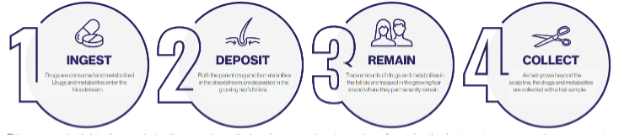
Hair testing is grounded in two very straightforward principles: how the body processes substances and how hair grows. When someone uses a drug, it enters the bloodstream as part of the body’s normal metabolic process. As hair grows beneath the scalp, trace amounts of those substances, and their metabolites, are carried through the blood supply to the hair follicle. From there, they become embedded within the hair shaft itself.
This is what gives hair testing its strength. Instead of capturing a single moment in time, hair creates a long-term record of drug use as it grows. That record isn’t on the surface, and it can’t be easily altered or removed. In fact, this biological process is what makes hair testing one of the most reliable and tamper-resistant drug screening methods available.
The graphic below illustrates the four key stages of drug incorporation into hair, showing how substances move from the bloodstream into the growing hair and remain locked into the structure over time.
Why Washing Doesn’t Change the Results
Shampoo is great at removing sweat, oils, and environmental residue. What it can’t do is reach deep enough into the hair shaft to remove substances that were incorporated during hair growth.
Professional hair testing labs also wash hair samples before testing to remove any external contamination. That step ensures results reflect actual use, not something the hair may have been exposed to after the fact. In other words, clean hair is expected. It doesn’t affect the outcome.
What About Dyeing or Bleaching?
Dyeing and bleaching change how hair looks and feels, so it’s easy to assume they might change test results, too. In reality, they don’t erase drug history. Drugs and their metabolites are distributed throughout the hair shaft, not concentrated in one layer that can be stripped away. While cosmetic treatments may alter hair texture, they don’t reliably remove what’s already embedded. Experienced laboratories also know how to evaluate treated hair and account for cosmetic processing during analysis.
Styling Products and “Detox” Claims
Gels, sprays, conditioners, and detox shampoos tend to promise a lot. What they actually do, is work only on the hair’s surface. To this day, there’s no credible scientific evidence that over-the-counter products can remove drug markers once they’re part of the hair structure.
Why This Reliability Is a Good Thing
The fact that hair testing can’t be easily manipulated is exactly why it’s trusted.
For employers and safety professionals, that means:
- Results don’t depend on grooming habits
- Attempts to mask drug use are far less effective
- Everyone is held to the same standard
It creates a more consistent and fair testing process, one focused on patterns over time, not quick workarounds.
How Hair Testing Differs From Other Methods
Urine and oral fluid testing can be useful for identifying very recent use, but their short detection windows limit their usefullness. Hair testing spans a longer period, typically up to 90 days, making it especially valuable for identifying ongoing or repeated use. That broader view is often what matters most in safety-sensitive environments.
Clearing Up the Myth
Hair testing isn’t about catching someone off guard; it’s about accuracy.
The idea that washing, dyeing, or styling can erase drug history misunderstands both hair biology and the science behind testing. Hair records what happens as it grows, and that record doesn’t disappear with a shampoo or a new color.
Why Psychemedics Leads the Way
As the original innovator in hair testing, Psychemedics has spent decades studying how hair behaves, how drugs are incorporated into hair, and how cosmetic treatments affect hair samples.
That experience allows us to deliver results employers can trust, results based on science, not assumptions.
What Hair Really Keeps
Hair doesn’t respond to quick fixes or cosmetic changes. It grows steadily, records what passes through the body, and holds onto that information over time. That’s what makes hair testing different. It isn’t influenced by how often someone washes their hair, what products they use, or whether they changed their color last week. It reflects behavior as it happened, gradually, consistently, and internally. For organizations that rely on accurate drug testing, that reliability matters. It means fewer assumptions, fewer loopholes, and more confidence in the results being used to make important decisions.
Hair doesn’t tell a story about yesterday, but tells a story about patterns. And when safety, trust, and accountability are on the line, that perspective makes all the difference.
References:
- “Does Hair Color Affect Hair Drug Tests? | Talcada.” Talcada |, 2 Jan. 2026, www.talcada.com/does-hair-color-affect-hair-drug-tests/.
- Branson, Sarah, et al. Recent Scientific Developments in Hair Strand Testing and Racial Bias in Current Practices of Hair Strand Testing.
- “FAQ: Hair Testing – Toxlogic.” Toxlogic, 14 Oct. 2025, toxlogic.com.au/faq-hair-testing/.
- “What Affects a Hair Drug Test Result? – Does Hair Dye Impact Hair Follicle Test? | AlphaBiolabs UK.” AlphaBiolabs, 2024, www.alphabiolabs.co.uk/learning-centre/what-affects-a-hair-drug-test-result/.