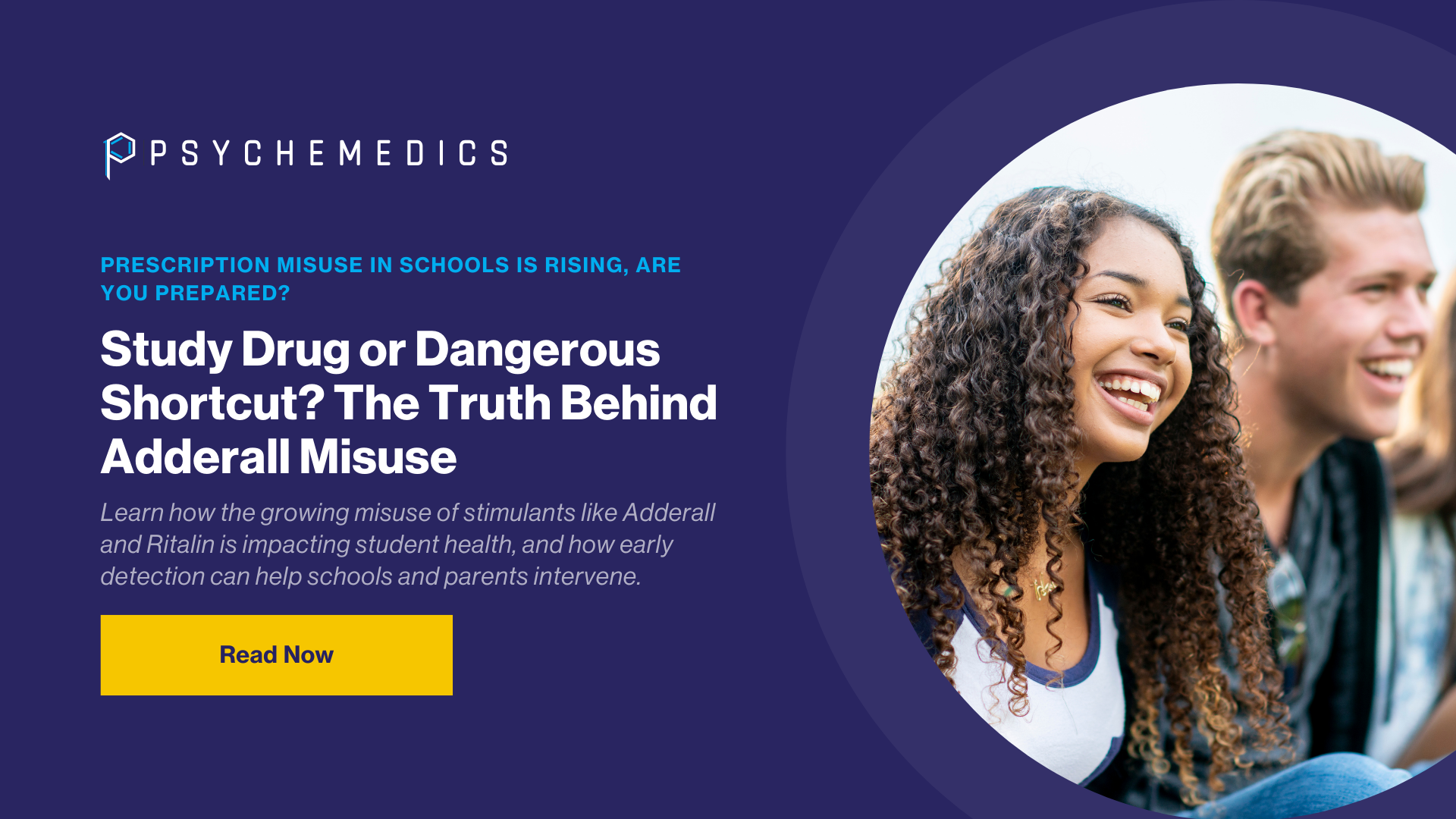
Prescription stimulants like Adderall and Ritalin are commonly prescribed to manage conditions such as ADHD. However, misuse of these medications among students, both in high school and college, has surged, posing serious health and safety risks. As the misuse escalates, schools and parents face a critical question: how can we detect and address this growing problem effectively while respecting student privacy?
At Psychemedics, we believe hair drug testing offers a powerful, accurate, and respectful solution to this challenge.
Understanding Prescription Stimulant Misuse
Students often misuse prescription stimulants to stay awake, improve concentration, or gain a competitive edge during exams and deadlines. This misuse is frequently seen as harmless “study aids,” but the reality is far more dangerous.
Key risks include:
- Increased heart rate and blood pressure
- Anxiety, paranoia, and mood disorders
- Dependence and addiction
- Risk of dangerous interactions with other substances
These consequences not only threaten individual health but can also impact academic performance and campus safety.
Why Traditional Drug Testing Falls Short
Many schools rely on urine or oral fluid testing to screen for substance use. While these methods detect recent drug use, they have significant limitations:
- Short detection windows: Oral fluid testing detects drug use only within hours or a few days. Urine testing similarly provides a limited snapshot.
- Susceptibility to tampering: Urine tests are vulnerable to adulteration or substitution, reducing their reliability.
- Invasiveness: Urine collection can be intrusive, raising privacy concerns and potentially eroding trust.
For addressing prescription stimulant misuse, often habitual and long-term, these traditional methods are insufficient.
The Advantages of Hair Drug Testing
Psychemedics’ hair drug testing technology overcomes these limitations, delivering unparalleled benefits:
- Extended detection window: Hair testing reveals drug use patterns over 90 days, capturing long-term misuse instead of just recent consumption.
- Non-intrusive collection: Collecting hair samples respects student privacy and dignity, unlike invasive urine collection.
- High integrity and accuracy: Hair samples are difficult to adulterate, and our collection process maintains scientific rigor and legal defensibility.
- Comprehensive insights: Detects habitual use patterns, enabling schools to intervene early and support at-risk students effectively.
Supporting a Culture of Accountability and Care
Hair drug testing is not about punishment; it’s a proactive deterrent. Knowing that long-term use can be detected encourages students to make safer choices. Furthermore, schools using hair testing can:
- Identify students who may need counseling or medical support
- Strengthen prevention programs with reliable data
- Maintain compliance with legal and ethical standards
- Build trust by balancing accountability with respect for privacy
Why Psychemedics?
Psychemedics Corporation is the global leader in hair drug testing for drugs of abuse, serving both workplace and educational communities for over 30 years. Our patented technology and scientific innovation have set the standard for accuracy, reliability, and legal defensibility in hair testing.
Trusted by thousands of organizations, including Fortune 500 companies, law enforcement agencies, and schools nationwide, Psychemedics helps create safer workplaces and healthier learning environments by detecting drug use with unparalleled precision. Whether supporting employers in building a drug-free workforce or helping schools intervene early to protect students, Psychemedics is committed to advancing public safety through proven science.
Moving Forward: A Smarter Approach to Student Safety
Prescription stimulant misuse among students is a pressing concern that demands a strategic and respectful response. Hair drug testing stands out as the superior solution, offering long-term accuracy, privacy protection, and actionable insights.
By integrating hair testing into their drug prevention strategies, schools can better safeguard student well-being while fostering a culture of accountability and trust.
References:
- Weyandt, Lisa L., et al. “Prescription Stimulant Medication Misuse: Where Are We and Where Do We Go from Here?” Experimental and Clinical Psychopharmacology, vol. 24, no. 5, Oct. 2016, pp. 400–414, www.ncbi.nlm.nih.gov/pmc/articles/PMC5113141/, https://doi.org/10.1037/pha0000093.
- Edinoff, Amber N., et al. “Prescription Stimulants in College and Medical Students: A Narrative Review of Misuse, Cognitive Impact, and Adverse Effects.” Psychiatry International, vol. 3, no. 3, 22 July 2022, pp. 221–235, https://doi.org/10.3390/psychiatryint3030018.
- Cole, Veronica T., and Andrea M. Hussong. “Psychosocial Functioning among College Students Who Misuse Stimulants versus Other Drugs.” Addictive Behaviors, vol. 105, June 2020, p. 106290, https://doi.org/10.1016/j.addbeh.2020.106290.
- “Misuse of Prescription Stimulants in Young Adults.” Mass General Advances in Motion, 25 Oct. 2018, advances.massgeneral.org/neuro/video.aspx?id=1032. Accessed 30 July 2025.